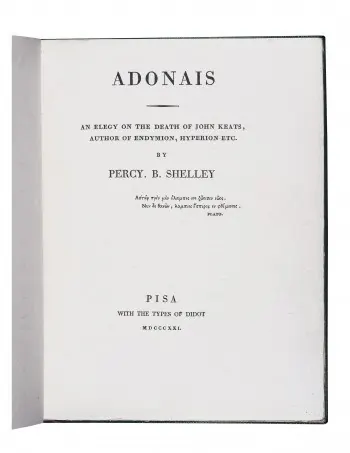
Adonais
Nota da comunidade
19 avaliações
1821 · Percy Bysshe Shelley
Médias por categoria
Sua avaliação
Entre para avaliarSinopse
Ainda não disponível em português — exibindo a versão em inglês.
Adonais: An Elegy on the Death of John Keats, Author of Endymion, Hyperion, etc. () is a pastoral elegy written by Percy Bysshe Shelley for John Keats in 1821, and widely regarded as one of Shelley's best and best-known works. The poem, which is in 495 lines in 55 Spenserian stanzas, was composed in the spring of 1821 immediately after 11 April, when Shelley heard of Keats's death (seven weeks earlier). It is a pastoral elegy, in the English tradition of John Milton's Lycidas. Shelley had studied and translated classical elegies. The title of the poem is modelled on ancient works, such as Achilleis (a poem about Achilles), an epic poem by the 1st-century AD Roman poet Statius, and refers to the untimely death of the Greek Adonis, a god of fertility. Some critics suggest that Shelley used Virgil's tenth Eclogue, in praise of Cornelius Gallus, as a model. It was published by Charles Ollier in July 1821 (see 1821 in poetry) with a preface in which Shelley made the mistaken assertion that Keats had died from a rupture of the lung induced by rage at the unfairly harsh reviews of his verse in the Quarterly Review and other journals. He also thanked Joseph Severn for caring for Keats in Rome. This praise increased literary interest in Severn's works.
Licença do texto: CC BY-SA 4.0 · Fonte
Detalhes
- Tipo
- Livro
- Lançamento
- 1 de janeiro de 1821
- Criado por
- Percy Bysshe Shelley
Capa: Wikimedia Commons · Percy Bysshe Shelley · Public domain · Fonte
