Astronomica
Nota da comunidade
31 avaliações
Marcus Manilius
Médias por categoria
Sua avaliação
Entre para avaliarSinopse
Ainda não disponível em português — exibindo a versão em inglês.
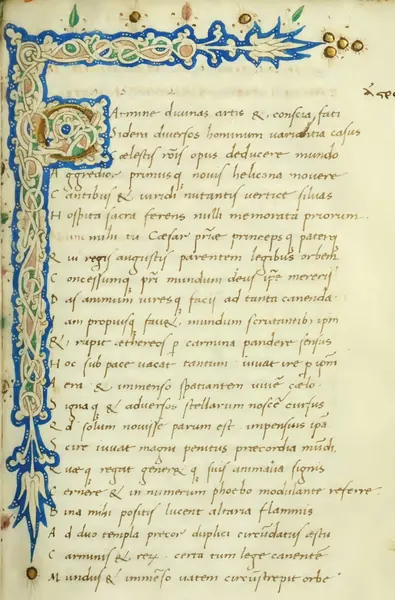
The Astronomica (Classical Latin: [astrɔˈnɔmɪka]), also known as Astronomicon, is a Latin didactic poem about celestial phenomena, written in hexameters and divided into five books. The Astronomica was written c. AD 30–40 by a Roman poet whose name was likely Marcus Manilius; little is known of Manilius, and although there is evidence that the Astronomica was probably read by many other Roman writers, no surviving works explicitly quote him. The earliest work on astrology that is extensive, comprehensible, and mostly intact, the Astronomica describes celestial phenomena, and, in particular, the zodiac and astrology. The poem—which seems to have been inspired by Lucretius's poem De rerum natura—espouses a Stoic, deterministic understanding of a universe overseen by a god and governed by reason. The fifth book contains a lacuna, which has led to debate about the original size of the poem; some scholars have argued that whole books have been lost over the years, whereas others believe only a small section of the work is missing. The poem was rediscovered c. 1416–1417 by the Italian humanist and scholar Poggio Bracciolini, who had a copy made from which the modern text derives. Since its rediscovery, the Astronomica has been read, commented upon, and edited by a number of scholars, most notably Joseph Justus Scaliger, Richard Bentley, and A. E. Housman. The poem was never as popular as other classical Latin poems and was neglected for centuries after its rediscovery. This started to change during the early 20th century when Housman published his critically acclaimed edition of the poem in five books (1903–30). Housman's work was followed by G. P. Goold's lauded English translation in 1977. Today, scholars consider the Astronomica to be highly technical, complicated, and occasionally contradictory. At the same time, many have praised Manilius's ability to translate heady astronomical concepts and complex mathematical computations into poetry.
Licença do texto: CC BY-SA 4.0 · Fonte
Detalhes
- Tipo
- Livro
- Criado por
- Marcus Manilius
- Países
- Roman Empire
Capa: Wikimedia Commons · Manilius (Latin author); Peregrinus Allius of Ferrara (scribe of manuscript) · Public domain · Fonte
