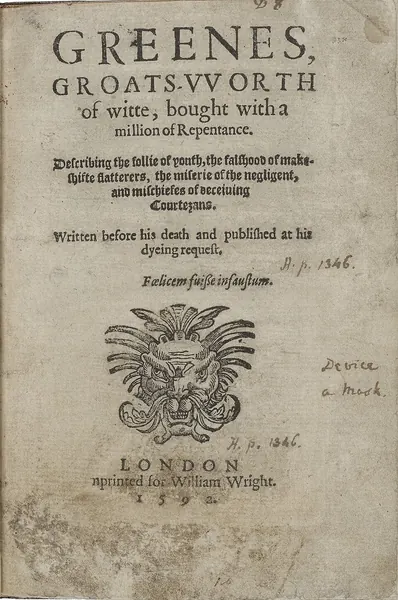
Greene's Groats-Worth of Wit
Nota da comunidade
6 avaliações
1592 · Robert Greene
Médias por categoria
Sua avaliação
Entre para avaliarSinopse
Ainda não disponível em português — exibindo a versão em inglês.
Greenes, Groats-worth of Witte, bought with a million of Repentance (1592) is a tract published as the work of the Elizabethan author Robert Greene. It was published as a short book or pamphlet, a form that was popular and which contributed to the lively intellectual life of the time. Greene's work is written as a moralistic tale, which, towards the end, is revealed to have been autobiographical. During the course of the story characters introduce song lyrics, fables, and some sharp and resentful criticisms of actors and playwrights. It appears to have been written with the idea that the contemporary reader would try to figure out which actual persons are being represented and satirised by the characters in the story. The pamphlet is most famous for a passage which appears to allude to William Shakespeare, who was then starting out on his career as an actor and playwright. The main body of the text is an account of the visit of two brothers, Roberto and Lucanio, to the courtesan Lamilia. This is followed by the later career of Roberto as a playwright. The actual authorship of the pamphlet has been disputed. Some authorities consider it to be wholly by Greene himself. Others take the view that it is a heavily revised compilation of material left by him. It has also been attributed to the writer and printer Henry Chettle, who arranged its publication.
Licença do texto: CC BY-SA 4.0 · Fonte
Detalhes
- Tipo
- Livro
- Lançamento
- 1 de janeiro de 1592
- Criado por
- Robert Greene
Capa: Wikimedia Commons · Robert Greene · Public domain · Fonte
.jpg)