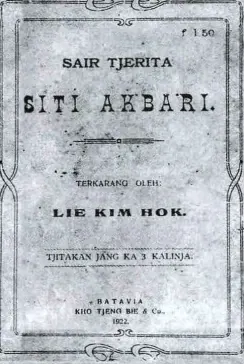
Sair Tjerita Siti Akbari
Nota de la comunidad
8 valoraciones
1884 · Lie Kim Hok
Promedios por categoría
Tu valoración
Inicia sesión para valorarSinopsis
Aún no disponible en español — se muestra la versión en inglés.
Sair Tjerita Siti Akbari ([ʃaˈir tʃeˈrita siˈti akˈbari]; Perfected spelling: Syair Cerita Siti Akbari, Malay for Poem on the Story of Siti Akbari; also known as Siti Akbari) is an 1884 Malay-language syair (poem) by Lie Kim Hok. Adapted indirectly from the Sjair Abdoel Moeloek, it tells of a woman who passes as a man to free her husband from the Sultan of Hindustan, who had captured him in an assault on their kingdom. Written over a period of several years and influenced by European literature, Siti Akbari differs from earlier syairs in its use of suspense and emphasis on prose rather than form. It also incorporates European realist views to expand upon the genre, although it maintains several of the hallmarks of traditional syairs. Critical views have emphasised various aspects of its story, finding in the work an increased empathy for women's thoughts and feelings, a call for a unifying language in the Dutch East Indies (now Indonesia), and a polemic regarding the relation between tradition and modernity. Siti Akbari was a commercial and critical success, seeing two reprints and a film adaptation in 1940. When Sjair Abdoel Moeloek's influence became clear in the 1920s, Lie was criticised as unoriginal. However, Siti Akbari remains one of the better known syairs written by an ethnic Chinese author. Lie was later styled as the "father of Chinese Malay literature".
Licencia del texto: CC BY-SA 4.0 · Fuente
Detalles
- Tipo
- Libro
- Estreno
- 1 de enero de 1884
- Creado por
- Lie Kim Hok
- Países
- Dutch East Indies
Portada: Wikimedia Commons · Cover: Uncredited Book: Lie Kim Hok · Public domain · Fuente
