Shirat ha-Yam
Nota de la comunidad
31 valoraciones
Promedios por categoría
Tu valoración
Inicia sesión para valorarSinopsis
Aún no disponible en español — se muestra la versión en inglés.
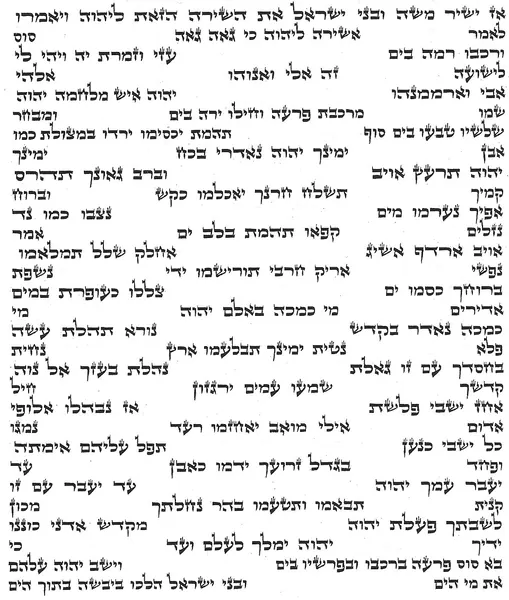
The Song of the Sea (Biblical Hebrew: שִׁירַת הַיָּם, romanized: širaṯ hayyām), also known as Az Yashir Moshe (אָז יָשִׁיר מֹשֶׁה "then Moses will sing") and Mi Chamocha (מִי־כָמֹכָה "Who is like You?"), is a poem that appears in the Hebrew Bible in the Book of Exodus 15:1–18. Its first two verses are repeated in verses 20 and 21, there said to be sung by Miriam and other Israelite women. The Song of the Sea was sung by the Israelites after their crossing the Red Sea in safety and celebrates their freedom after generations of slavery and oppression by the Egyptians. The poem is included in Jewish prayer books (siddurim) and recited daily during Shaharit. The poem forms part of the sixteenth weekly Torah portion, parashat Beshalach. The Shabbat on which it is read is known as (Hebrew: שַׁבַּת שִׁירָה, romanized: Shabbat Shirah, lit. 'Shabbat of Song'. It is one of only two sections of the Torah scroll written in a layout different from simple columns. The other section is the Song of Moses at the end of Deuteronomy, in the 53rd weekly portion (parashat Ha'azinu). The poem also comprises the first hymn of the Eastern Orthodox canon, in which it is known as the Song of Moses. It is also used in the Catholic Church and other Christian liturgies the Easter Vigil, when the salvation history as believed by Christians is recounted. The Christian traditions follow Revelation 15:3 by calling it the "Song of Moses" (not to be confused with the Song of Moses in Deuteronomy).
Licencia del texto: CC BY-SA 4.0 · Fuente
Detalles
- Tipo
- Libro
- Géneros
- biblical poetry
Portada: Wikimedia Commons · Elihu Shanun · Copyrighted free use · Fuente
