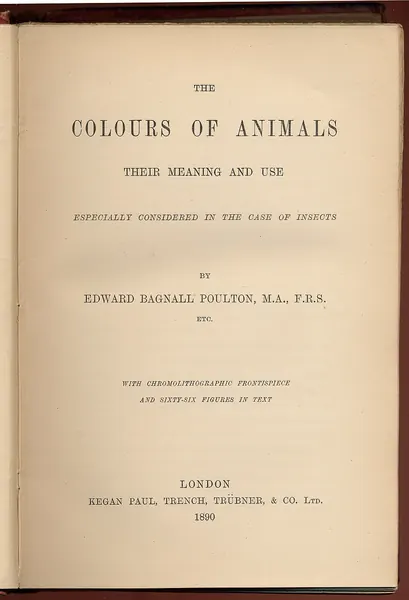
The Colours of Animals
Nota de la comunidad
6 valoraciones
Edward Bagnall Poulton
Promedios por categoría
Tu valoración
Inicia sesión para valorarSinopsis
Aún no disponible en español — se muestra la versión en inglés.
The Colours of Animals is a zoology book written in 1890 by Sir Edward Bagnall Poulton (1856–1943). It was the first substantial textbook to argue the case for Darwinian selection applying to all aspects of animal coloration. The book also pioneered the concept of frequency-dependent selection and introduced the term "aposematism". The book begins with a brief account of the physical causes of animal coloration. The second chapter gives an overview of the book, describing the various uses of colour in terms of the advantages it can bring through natural selection. The next seven chapters describe camouflage, both in predators and in prey. Methods of camouflage covered include background matching, resemblance to specific objects such as bird droppings, self-decoration with materials from the environment, and the seasonal colour change of arctic animals. Two chapters cover warning colours, including both Batesian mimicry, where the mimic is edible, and Müllerian mimicry, where distasteful species mimic each other. A chapter then looks at how animals combine multiple methods of defence, for instance in the puss moth. Two chapters examine coloration related to sexual selection. Finally Poulton summarizes the subject with a fold-out table including a set of Greek derived words that he invented, of which "aposematic" and "cryptic" survive in biological usage. The Colours of Animals was well received on its publication, although the book's support for sexual selection was criticised by Alfred Russel Wallace, and its Darwinism and critique of Lamarckism were attacked by Edward Drinker Cope. Wallace liked Poulton's experimental work but was critical of his opinions on sexual selection. The Neo-Lamarckian Cope criticised Poulton's support for Darwin but liked the book's many observations of animal coloration. Modern biologists respect Poulton's advocacy of natural selection and sexual selection, despite the lack at the time of an adequate theory of heredity, and his recognition of frequency-dependent selection.
Licencia del texto: CC BY-SA 4.0 · Fuente
Detalles
- Tipo
- Libro
- Creado por
- Edward Bagnall Poulton
- Países
- United Kingdom
Portada: Wikimedia Commons · Edward Bagnall Poulton · Public domain · Fuente
