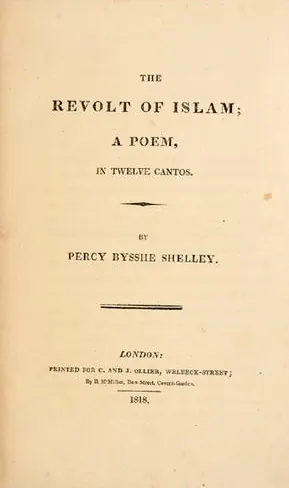
The Revolt of Islam
Nota de la comunidad
9 valoraciones
1818 · Percy Bysshe Shelley
Promedios por categoría
Tu valoración
Inicia sesión para valorarSinopsis
Aún no disponible en español — se muestra la versión en inglés.
The Revolt of Islam (1818) is a poem in twelve cantos composed by Percy Bysshe Shelley in 1817. The poem was originally published under the title Laon and Cythna; or, The Revolution of the Golden City: A Vision of the Nineteenth Century by Charles and James Ollier in December 1817. Shelley composed the work in the vicinity of Bisham Woods, near Great Marlow in Buckinghamshire, northwest of London, from April to September. The plot centres on two characters named Laon and Cythna, inhabitants of Argolis under Ottoman rule who initiate a revolution against its despotic ruler. Despite its title, the poem is not focused on Islam as a specific religion, though the general subject of religion is addressed, and the work draws on Orientalist archetypes and themes. The work is a symbolic parable on liberation and revolutionary idealism following the disillusionment of the French Revolution. Laon and Cythna lead a peaceful, nonviolent revolution against the tyrannical Sultan Othman to achieve liberty, equality, and intellectual freedom. A Hermit befriends Laon, mentors him, and frees him from captivity. The poem was the subject of discussion among Shelley scholars during the Arab Spring that emerged in the early 2010s.
Licencia del texto: CC BY-SA 4.0 · Fuente
Detalles
- Tipo
- Libro
- Estreno
- 1 de enero de 1818
- Géneros
- poetry
- Creado por
- Percy Bysshe Shelley
- Países
- United Kingdom
Portada: Wikimedia Commons · Percy Byshe Shelley. Published in Lodon by C. and J. Ollier. · Public domain · Fuente
