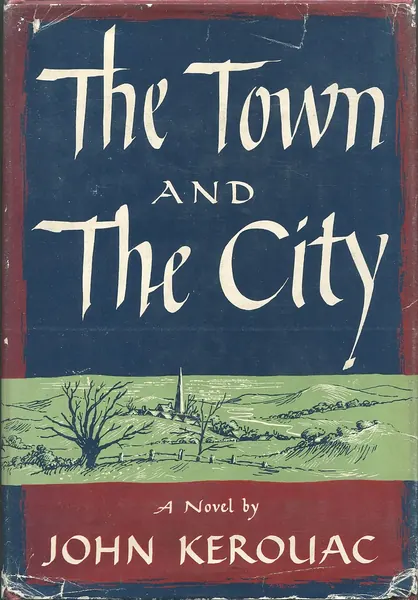
The Town and the City
Nota de la comunidad
16 valoraciones
1950 · Jack Kerouac
Promedios por categoría
Tu valoración
Inicia sesión para valorarEn otros sitios
Las notas de otros sitios les pertenecen; cada enlace abre la fuente.
Sinopsis
Aún no disponible en español — se muestra la versión en inglés.
The Town and the City is a novel by Jack Kerouac, published by Harcourt Brace in 1950. This was the first major work published by Kerouac, who later became famous for his second novel On the Road (1957). Like all of Jack Kerouac's major works, The Town and the City is essentially an autobiographical novel, though less directly so than most of his other works. The Town and the City was written in a conventional manner over a period of years, and much more novelistic license was taken with this work than after Kerouac's adoption of quickly written "spontaneous prose". The Town and the City was written before Kerouac had developed his own style, and it is heavily influenced by Thomas Wolfe (even down to the title, reminiscent of Wolfe titles such as The Web and the Rock). The novel is focused on two locations (as suggested by the title): one, the early Beat Generation circle of New York in the late 1940s, the other, the nearly rural small town of Galloway, Massachusetts, that the main character comes from, before going off to college on a football scholarship. Galloway represents the city of Lowell, Massachusetts, which the Merrimack River runs through, and where Kerouac was raised. The experiences of the young "Peter Martin" are largely those of Jack Kerouac (he returns to the subject again in his last work Vanity of Duluoz, published in 1968). The book gives great insight in the events that shaped Jack Kerouac as a person and as a writer. The "city" represents a number of figures of the early beat circle: Allen Ginsberg (as Leon Levinsky), Lucien Carr (as Kenneth Wood), William Burroughs (as Will Dennison), Herbert Huncke (as Junkey), David Kammerer (as Waldo Meister), Edie Parker (as Judie Smith) and also Joan Vollmer (as Mary Dennison) – though she essentially has a non-speaking role (however some of her ideas are quoted by the Ginsberg-figure). Near the end of the novel, the Waldo Meister character dies by falling from the window of Kenneth Wood's apartment (a distant echo of the real event: David Kammerer knifed by Lucien Carr, possibly in self-defense). In the novel the police largely just accept this as a suicide. A version of the events closer to the truth can be found in Vanity of Duluoz, in which Carr was arrested and eventually accepted a plea of manslaughter and a prison sentence; and Kerouac was arrested and held briefly as an accessory after the fact. Still another version of the story can be found in an early novel Kerouac collaborated on with William S. Burroughs, And the Hippos Were Boiled in Their Tanks, published after Kerouac's death.
Licencia del texto: CC BY-SA 4.0 · Fuente
Detalles
- Tipo
- Libro
- Estreno
- 1 de enero de 1950
- Creado por
- Jack Kerouac
- Países
- United States
Portada: Wikimedia Commons · Jacket design by Leo Manso · Public domain · Fuente
