Yunjing
Nota da comunidade
9 avaliações
Médias por categoria
Sua avaliação
Entre para avaliarSinopse
Ainda não disponível em português — exibindo a versão em inglês.
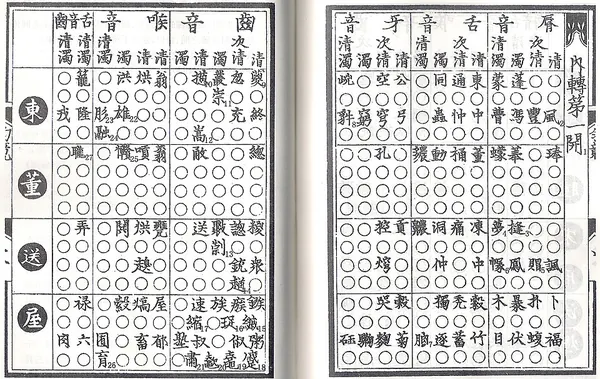
The Yunjing is one of the two oldest existing examples of a Chinese rime table – a series of charts which arrange Chinese characters in large tables according to their tone and syllable structures to indicate their proper pronunciations. Current versions of the Yunjing date to AD 1161 and 1203 editions published by Zhang Linzhi (張麟之). The original author(s) and date of composition of the Yunjing are unknown. Some of its elements, such as certain choices in its ordering, reflect features particular to the Tang dynasty, but no conclusive proof of an actual date of composition has yet been found. The Yunjing contains 43 tables (Chinese: 轉; pinyin: zhuǎn; lit. 'turnings'), each of which tabulates combinations of a particular final rhyme (listed in rows) with various initials (listed in columns), in up to four tones, to show in a grid pattern all possible syllables. Empty circles on the grid denote that the authors were unaware of any word with that particular pronunciation. By locating a character in Yunjing, a reader could identify its initial consonant (by looking at its column) and its "rhyme", or main vowel and ending consonant (by looking at its row), and combine the two to obtain the word's pronunciation. Zhang Linzhi's prefaces list a total of 36 possible initial consonants (聲母; shēngmǔ) – by comparison, modern Standard Chinese only has 23 and modern Cantonese only has 18 or 19. Historical Chinese phonology uses the Yunjing as an accurate representation of Late Middle Chinese (10th–12th century) phonology. The Yunjing's use of this system represents a significant advancement in the Chinese' analysis of their own language, and is believed to have been inspired by their studies of Sanskrit phonological treatises and Buddhist mantras written in the Siddham script during the Sui and Tang dynasties.
Licença do texto: CC BY-SA 4.0 · Fonte
Detalhes
- Tipo
- Livro
Capa: Wikimedia Commons · Public domain · Fonte
