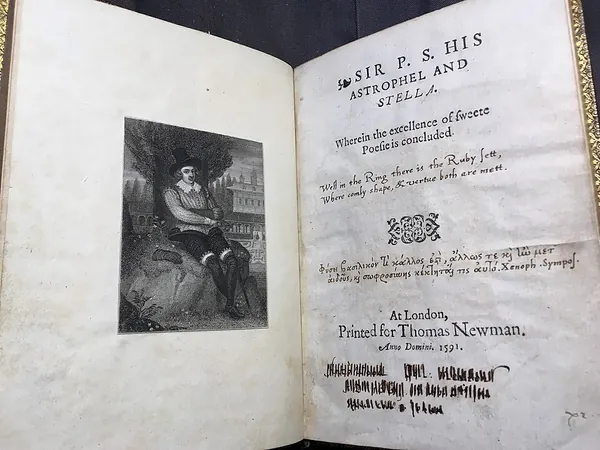
Astrophel and Stella
Nota de la comunidad
13 valoraciones
1591 · Philip Sidney
Promedios por categoría
Tu valoración
Inicia sesión para valorarEn otros sitios
Las notas de otros sitios les pertenecen; cada enlace abre la fuente.
Sinopsis
Aún no disponible en español — se muestra la versión en inglés.
Astrophil and Stella is an English sonnet sequence by Philip Sidney containing 108 sonnets and 11 songs, probably composed in the 1580s. The name derives from the two Greek words, 'aster' (star) and 'phil' (lover), and the Latin word 'stella' meaning star. Thus Astrophil is the star lover, and Stella is his star. Sidney partly nativized the key features of his Italian model Petrarch, including an ongoing but partly obscure narrative, the philosophical trappings of the poet in relation to love and desire, and musings on the art of poetic creation. Sidney also adopts the Petrarchan rhyme scheme, though he uses it with such freedom that fifteen variants are employed. Some have suggested that the love represented in the sequence may be a literal one as Sidney evidently connects Astrophil to himself and Stella to Lady Penelope, thought to be Penelope Devereux (1563–1607), later Lady Rich, the wife of Robert Rich, 3rd Baronet. Sidney and Lady Penelope had been betrothed when the latter was a child. For some reason the match was broken off, and Lady Penelope married Lord Rich, with whom she lived for a while most unhappily. Payne and Hunter suggest that modern criticism, though not explicitly rejecting this connection, leans more towards the viewpoint that writers happily create a poetic persona, artificial and distinct from themselves.
Licencia del texto: CC BY-SA 4.0 · Fuente
Detalles
- Tipo
- Libro
- Estreno
- 1 de enero de 1591
- Creado por
- Philip Sidney
Portada: Wikimedia Commons · DavidPKendal · CC0 · Fuente
