Political Parties
Nota de la comunidad
7 valoraciones
1911 · Robert Michels
Promedios por categoría
Tu valoración
Inicia sesión para valorarSinopsis
Aún no disponible en español — se muestra la versión en inglés.
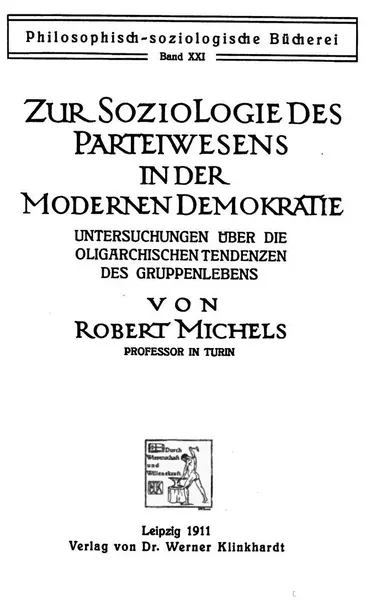
Political Parties: A Sociological Study of the Oligarchical Tendencies of Modern Democracy (German: Zur Soziologie des Parteiwesens in der modernen Demokratie; Untersuchungen über die oligarchischen Tendenzen des Gruppenlebens) is a book by the German-born Italian sociologist Robert Michels, published in 1911 and first introducing the concept of iron law of oligarchy. It is considered one of the classics of social sciences, in particular sociology and political science. It was translated to Italian as Sociologia del partito politico nella democrazia moderna: studi sulle tendenze oligarchiche degli aggregati politici by Alfredo Polledro in 1912, and then translated from the Italian to English by Eden Paul and Cedar Paul for Hearst's International Library Co. in 1915. This work analyses the power structures of organizations such as political parties and trade unions. Michels's main argument is that all organizations, even those in theory most egalitarian and most committed to democracy – like socialist political parties – are in fact oligarchical, and dominated by a small group of leadership. The book also provides a first systematic analysis of how a radical political party loses its radical goals under the dynamics of electoral participation. The origins of moderation theory can be found in this analysis.
Licencia del texto: CC BY-SA 4.0 · Fuente
Detalles
- Tipo
- Libro
- Estreno
- 1 de enero de 1911
- Creado por
- Robert Michels
- Países
- Germany
Portada: Wikimedia Commons · Unknown authorUnknown author · Public domain · Fuente
