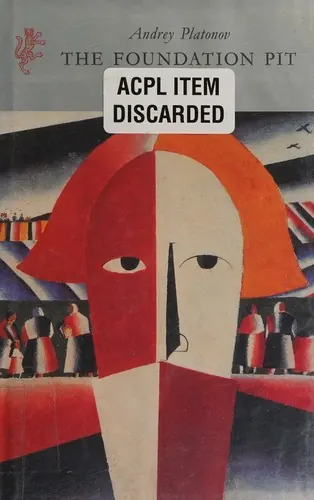
The Foundation Pit
Nota de la comunidad
14 valoraciones
1969 · Andrei Platonov
Promedios por categoría
Tu valoración
Inicia sesión para valorarEn otros sitios
Las notas de otros sitios les pertenecen; cada enlace abre la fuente.
Sinopsis
Aún no disponible en español — se muestra la versión en inglés.
The Foundation Pit (Russian: Котлован, romanized: Kotlovan) is a symbolic and semi-satirical novel by Andrei Platonov. The plot of the novel concerns a group of workers living in the early Soviet Union. They attempt to dig out a huge foundation pit on the base of which a gigantic house will be built for the country's proletarians. As the novel progresses, the workers slowly cease to understand the meaning of their work, as the labor required to dig the pit saps their physical and mental energy. In terms of creative works, Platonov depicted one of the first state-controlled dystopias of the 20th century. The novel is often compared to George Orwell's Nineteen Eighty-Four and Aldous Huxley's Brave New World. However, some critics say that The Foundation Pit cannot be regarded as a dystopian novel, as dystopian novels describe a catastrophic future, while Platonov's work describes the present, and the author's attitude cannot be called unambiguously critical. Platonov's work is a representation of the conflict that arose between Russian individuals and the increasingly collectivized Soviet state in the late 1920s. Finished in 1930, the novel was not published in the Soviet Union until 1987 due to censorship. The Foundation Pit is considered a modernist work. Joseph Brodsky wrote: "Platonov ... should be recognized as the first serious surrealist. I say - first, despite Kafka, because surrealism is by no means an aesthetic category, associated in our view, as a rule, with an individualistic worldview, but a form of philosophical fury, a product of the psychology of a dead end".
Licencia del texto: CC BY-SA 4.0 · Fuente
Detalles
- Tipo
- Libro
- Estreno
- 1 de enero de 1969
- Creado por
- Andrei Platonov
- Países
- Soviet Union