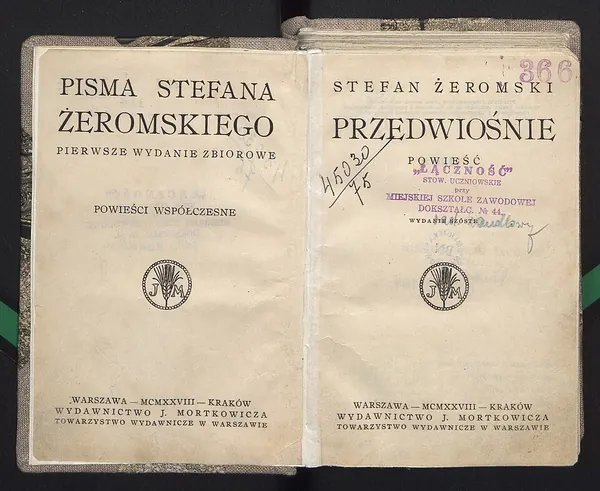
The Spring to Come
Nota de la comunidad
14 valoraciones
1925 · Stefan Żeromski
Promedios por categoría
Tu valoración
Inicia sesión para valorarEn otros sitios
Las notas de otros sitios les pertenecen; cada enlace abre la fuente.
Sinopsis
Aún no disponible en español — se muestra la versión en inglés.
Przedwiośnie (a title translated as First Spring, Before the Spring, Early Spring, Springtime, or, most commonly, as The Spring To Come) is a novel by Polish neoromantic writer Stefan Żeromski, and first published in 1925, the year he died. The book has been translated and published in the U.S. as The Coming Spring in 2007. The novel consists of three parts: Szklane Domy (Glass Houses), Nawłoć (Nawłoć [Estate]), and Wiatr od wschodu (The Eastern Wind). It is set between 1914–1924, before and during the reconstitution of Poland as the Second Polish Republic, including the Polish–Soviet War. As the Russian Revolution breaks out, the main character, Cezary Baryka, escapes from Baku with his father, a Polish political exile from Siberia (see also, Poles in Azerbaijan). The father dies en route to the newly formed Polish state. Cezary enters Poland alone, the country of his parents, having never been there before. The novel tells of his disillusionment as the Poland he discovers does not resemble that of which his father told him, a feeling only magnified by the Baryka's deep suspicion of the Bolshevik solutions about the poor. In 1928, an adaptation of the novel was premiered, directed by Henryk Szaro – the film is now considered lost. A live action version was released in two formats in Poland on 2 March 2001, adapted and directed by Filip Bajon, produced by Dariusz Jabłoński, and featuring Mateusz Damięcki as Cezary Baryka. It was the third most popular film in Poland for the year with 1.7 million admissions. A five-hour miniseries version was broadcast on Polish television, and a 138-minute cut distributed to theatres.
Licencia del texto: CC BY-SA 4.0 · Fuente
Detalles
- Tipo
- Libro
- Estreno
- 1 de enero de 1925
- Creado por
- Stefan Żeromski
Portada: Wikimedia Commons · Stefan Żeromski · CC0 · Fuente
