Promedios por categoría
Tu valoración
Inicia sesión para valorarSinopsis
Aún no disponible en español — se muestra la versión en inglés.
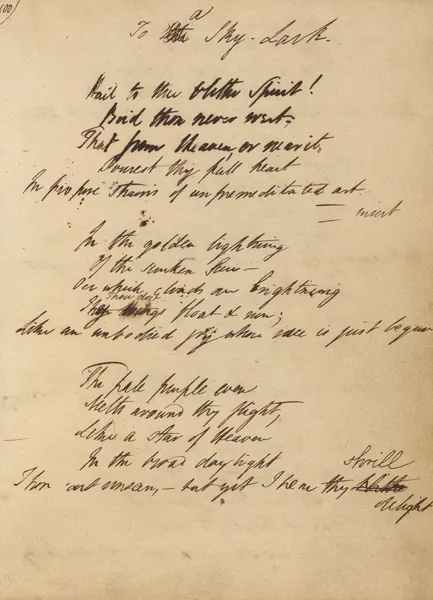
"To a Skylark" is a poem completed by Percy Bysshe Shelley in late June 1820 and published accompanying his lyrical drama Prometheus Unbound by Charles and James Ollier in London. It was inspired by an evening walk in the country near Livorno, Italy, with his wife Mary Shelley, and describes the appearance and song of a skylark they come upon. Mary Shelley described the event that inspired Shelley to write "To a Skylark": "In the Spring we spent a week or two near Leghorn (Livorno) ... It was on a beautiful summer evening while wandering among the lanes whose myrtle hedges were the bowers of the fire-flies, that we heard the carolling of the skylark." Alexander Mackie argued in 1906 that the poem, along with John Keats' "Ode to a Nightingale", "are two of the glories of English literature": "The nightingale and the lark for long monopolised poetic idolatry—a privilege they enjoyed solely on account of their pre-eminence as songbirds. Keats's Ode to a Nightingale and Shelley's Ode to a Skylark are two of the glories of English literature, but both were written by men who had no claim to a special or exact knowledge of ornithology as such." Shelley invokes the skylark as symbolic of nature and the divine or spiritual by showing that its song is pure, spontaneous, and "unpremeditated". It is compared to a poet, a maiden, a glow-worm, and a rose but surpasses them all. Humanity is burdened by sorrow and the fear of death which prevents such joy as the skylark knows.
Licencia del texto: CC BY-SA 4.0 · Fuente
Detalles
- Tipo
- Libro
- Estreno
- 1 de enero de 1820
- Géneros
- poetry
- Creado por
- Percy Bysshe Shelley
Portada: Wikimedia Commons · Percy Bysshe Shelley · Public domain · Fuente
