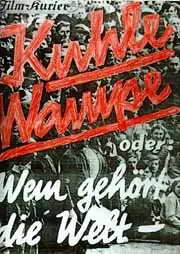
Kuhle Wampe or Who Owns the World?
Nota de la comunidad
10 valoraciones
1932 · Slatan Dudow
Promedios por categoría
Tu valoración
Inicia sesión para valorarEn otros sitios
Las notas de otros sitios les pertenecen; cada enlace abre la fuente.
Sinopsis
Aún no disponible en español — se muestra la versión en inglés.
Kuhle Wampe (full title: Kuhle Wampe, oder: Wem gehört die Welt?, translated in English as Kuhle Wampe or Who Owns the World?, and released in the USA as Whither Germany? by Kinematrade Inc.) is a 1932 German feature film about unemployment, homelessness and left wing politics in the Weimar Republic produced by Prometheus Film. The film was conceived and directed by Slatan Dudow, who brought the idea to Bertolt Brecht, who wrote the screenplay in collaboration with Ernst Ottwalt. Brecht also directed the concluding scene: a political debate between strangers on a train about the world coffee market. The film music was composed by Hanns Eisler. Kuhle Wampe itself was a tent camp on the Müggelsee in Berlin. Wampe is Berlin dialect for "stomach", so the title could be rendered "Empty Stomach". The film was banned in Germany in 1932 due to the accusations that it depicted the president, the legal system, and religion in a negative light but, following protests, the ban was lifted for a recut version. The film remained unseen for many years. However, a restored print is now available and a video was released by the British Film Institute in 1999, along with a documentary video essay on the original film by Andrew Hoellering, son of the film's producer George Hoellering.
Licencia del texto: CC BY-SA 4.0 · Fuente
Detalles
- Tipo
- Película
- Estreno
- 1 de enero de 1932
- Géneros
- drama film, proletarian film
- Creado por
- Slatan Dudow
- Duración
- 74 min
- Países
- Germany, Weimar Republic
Portada: Wikimedia Commons · unknown (originally uploaded by de:user:Boreali) · CC BY-SA 3.0 · Fuente
