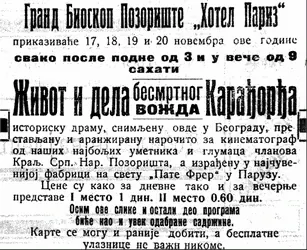
The Life and Deeds of the Immortal Vožd Karađorđe
Nota de la comunidad
5 valoraciones
1911 · Ilija Stanojević
Promedios por categoría
Tu valoración
Inicia sesión para valorarEn otros sitios
Las notas de otros sitios les pertenecen; cada enlace abre la fuente.
Sinopsis
Aún no disponible en español — se muestra la versión en inglés.
The Life and Deeds of the Immortal Leader Karađorđe (Serbian: Живот и дела бесмртног вожда Карађорђа, romanized: Život i dela besmrtnog vožda Karađorđa), or simply Karađorđe (Serbian Cyrillic: Карађорђе), is a 1911 Serbian silent film directed by Ilija Stanojević and starring Milorad Petrović. It was the first feature film released in Serbia and the Balkans. Petrović portrays the eponymous rebel leader Karađorđe, who led the First Serbian Uprising of 1804–1813. Karađorđe was first conceived by the aspiring film producer Svetozar Botorić, the owner of Serbia's first cinema. Following an unsuccessful attempt to secure government funding for the project, Botorić decided to personally finance the film. Actors from the National Theatre were cast in the leading roles. Botorić had worked with a cinematographer, Louis de Beéry, in the past for filming newsreels, and used him again. Principal photography ran through July and August 1911, and took place in and around Belgrade. The film was well received following its Belgrade premiere in October 1911. Although it was financially successful at home, Pathé opted not to distribute it abroad. The decision steered Botorić into precarious financial straits, as the film's domestic box office revenues were barely enough to cover the cost of production. After several further unsuccessful attempts at getting international distribution for his films, Botorić left the film industry altogether. In 1928, Karađorđe was last screened to a group of Serbian émigrés living in the United States. The last known copy went missing in 1947 or 1948, and for many decades thereafter, the film was considered lost. In July 2003, a largely intact copy was discovered in Vienna by researchers from the Yugoslav Film Archive. The film was subsequently restored in time to be screened on the 200th anniversary of the outbreak of the First Serbian Uprising, in February 2004. The film underwent digital restoration in 2011; the digitally restored version of Karađorđe was subsequently screened on the 100th anniversary of its release. In December 2016, the Yugoslav Film Archive declared the film to be a piece of "cultural heritage of exceptional importance".
Licencia del texto: CC BY-SA 4.0 · Fuente
Detalles
- Tipo
- Película
- Estreno
- 1 de enero de 1911
- Géneros
- drama film, silent film
- Creado por
- Ilija Stanojević
- Duración
- 80 min
- Países
- Kingdom of Serbia
Portada: Wikimedia Commons · Ilija Stanojević · Public domain · Fuente
