Promedios por categoría
Tu valoración
Inicia sesión para valorarEn otros sitios
Las notas de otros sitios les pertenecen; cada enlace abre la fuente.
Sinopsis
Aún no disponible en español — se muestra la versión en inglés.
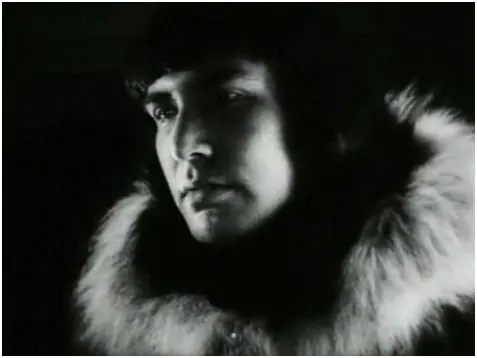
Eskimo (also known as Mala the Magnificent and Eskimo Wife-Traders) is a 1933 American pre-Code drama film directed by W. S. Van Dyke and released by Metro-Goldwyn-Mayer (MGM). It is based on the books Der Eskimo and Die Flucht ins weisse Land by Danish explorer and author Peter Freuchen. The film stars Ray Mala as Mala, Lulu Wong Wing as Mala's first wife Aba, Lotus Long as Mala's second wife Iva, Peter Freuchen as the Ship Captain, W. S. Van Dyke as Inspector White, and Joseph Sauers as Sergeant Hunt. Eskimo was the first feature film to be shot in a Native American language (Inupiat), although the AFI Catalog of Feature Films lists several earlier features shot in Alaska beginning in the later teens with The Barrier (1917), The Girl Alaska (1919), Back to God's Country (1919), and Heart of Alaska (1924). Eskimo documented many of the hunting and cultural practices of Native Alaskans. The production for the film was based at Teller, Alaska, where housing, storage facilities, a film laboratory, and other structures were built to house the cast, crew, and equipment. Eskimo was nicknamed "Camp Hollywood" with a crew that included 42 cameramen and technicians, six airplane pilots, and Emil Ottinger — a chef from the Hollywood Roosevelt Hotel. Numerous locations were used for filming, including Cape Lisburne in March 1933, Point Hope and Cape Serdtse-Kamen in April to July, and Herald Island in the Chukchi Sea in July. The film crew encountered difficulties recording native speech due to the "kh" sound of the native language. Altogether, pre-production, principal photography, and post-production took 17 months. The motion picture was well received by critics upon release on November 14, 1933, and received the first-ever Oscar for Best Film Editing, although it did not fare well at the box office. Scholar Peter Geller has more recently criticized the film as depicting the Eskimo as childlike, simple, and mythic "noble savages" rather than as human beings.
Licencia del texto: CC BY-SA 4.0 · Fuente
Detalles
- Tipo
- Película
- Estreno
- 1 de enero de 1933
- Géneros
- drama film
- Creado por
- W. S. Van Dyke
- Duración
- 108 min
- Países
- United States
Portada: Wikimedia Commons · Trailer screenshot · Public domain · Fuente
