The Gaucho War
Nota da comunidade
5 avaliações
1942 · Lucas Demare
Médias por categoria
Sua avaliação
Entre para avaliarEm outros sites
Notas de outros sites pertencem a eles; cada link abre a fonte.
Sinopse
Ainda não disponível em português — exibindo a versão em inglês.
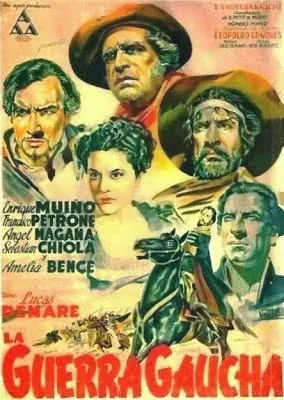
The Gaucho War (La guerra gaucha) is a 1942 Argentine historical drama and epic film directed by Lucas Demare and starring Enrique Muiño, Francisco Petrone, Ángel Magaña, and Amelia Bence. It is one of the most celebrated works of the Golden Age of Argentine cinema. The film's script, written by Homero Manzi and Ulyses Petit de Murat, is based on the novel by Leopoldo Lugones published in 1905. The film premiered in Buenos Aires on November 20, 1942, and is considered by critics of Argentine cinema to be one of the most successful films in history. It won three Silver Condor awards, including Best Film, Best Director (Lucas Demare), and Best Adapted Screenplay (Ulises Petit de Murat and Homero Manzi), given by the Argentine Film Critics Association at the 1943 Argentine Film Critics Association Awards for the best films and performances of the previous year. The film is set in 1817 in the Salta Province of northwest Argentina during the Argentine War of Independence. It is based on the actions taken by the guerrillas under the command of the general Martin Güemes against the royalist army, loyal to the Spanish monarchy. For exterior filming, a village was established in the same area where the actual conflict had taken place. The cast of some thousand participants was unprecedented in Argentine cinema until that time. The origins and content of the film are linked to a particular moment in Argentine history in which there was an intense debate over whether the country should take the side of either the Axis or the Allies during World War II, or maintain its neutrality during the war. The film stresses the values associated with nationalism as expressed in the union of the people, the army, and the church in defense of the country, which was considered by some a prelude to the revolutionary ideology that led to, on June 4, 1943, the overthrowing of the government of president Ramón Castillo. The film was produced by Artistas Argentinos Asociados (Associated Argentine Artists), a cooperative of artists created just a short time before production began. It required an investment far beyond other productions of the period but the commercial success of the film allowed it to recover the cost in the first-run theaters, where it remained for nineteen weeks. It was selected as the third greatest Argentine film of all time in the polls conducted by the Museo del Cine Pablo Ducrós Hicken in 1977 and 1984, while it ranked 7th in the 2000 edition. In a new version of the survey organized in 2022 by the specialized magazines La vida util, Taipei and La tierra quema, presented at the Mar del Plata International Film Festival, the film reached the 49 position.
Licença do texto: CC BY-SA 4.0 · Fonte
Detalhes
- Tipo
- Filme
- Lançamento
- 1 de janeiro de 1942
- Gêneros
- drama film, historical film
- Criado por
- Lucas Demare
- Duração
- 95 min
- Países
- Argentina
Capa: Wikimedia Commons · Unknown authorUnknown author · Public domain · Fonte
