Médias por categoria
Sua avaliação
Entre para avaliarSinopse
Ainda não disponível em português — exibindo a versão em inglês.
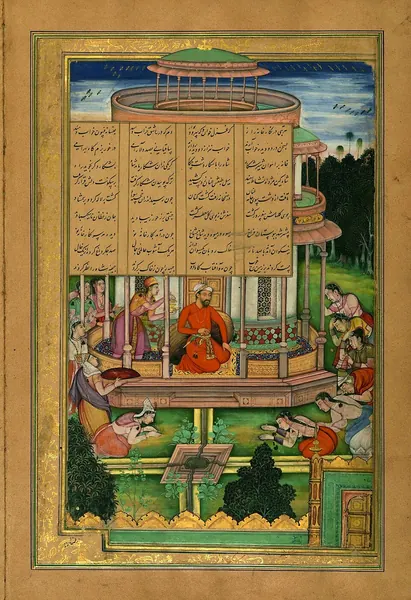
Hasht Bihisht (Persian: هشت بهشت, lit. 'Eight Paradises') is a collection of speeches (or narrative poems) authored by the Indo-Persian poet Amir Khusraw around 1302. Written in Persian, it forms the final poem in Khusraw’s Khamsah (quintet) and is modeled on Nizami Ganjavi’s Haft Paykar (c. 1197), which itself draws inspiration from Firdausi’s Shahnameh (c. 1010). Like Nizami's Haft Paykar, Khusraw's Hasht Bihisht uses a legend about Bahram V Gur as its frame story and, in the style of One Thousand and One Nights, introduces folktales told by seven princesses. Most famously, Khusraw appears to be the first writer to have added The Three Princes of Serendip, including the well-known episode involving the detection of a camel’s features through inference. The eight "paradises" in the poem link closely with the Islamic conception of Heaven with its eight gates and eight spaces, each one decorated with a special precious stone or material. Seven of the eight paradises are pavilions constructed for Bahram's "therapy" of storytelling. There is also a link to the architectural and garden plan of eight paradises. These serve as the backdrop for Bahram’s metaphorical transformation from a pleasure-seeking ruler to a wise sovereign. A deluxe illustrated manuscript of Khamsah-i Dihlavī, including Hasht Bihisht, was produced in Lahore during the reign of Mughal emperor Akbar (r. 1556–1605) by the celebrated calligrapher Muḥammad Ḥusayn al-Kashmīrī, known as Zarrīn Qalam. The manuscript (W.624), now held by the Walters Art Museum in Baltimore, Maryland, features elaborate miniatures by prominent painters of the Mughal atelier and is considered a significant example of Persianate literary and artistic tradition under imperial patronage.
Licença do texto: CC BY-SA 4.0 · Fonte
Detalhes
- Tipo
- Livro
- Lançamento
- 1 de janeiro de 1301
- Gêneros
- poetry
- Criado por
- Amir Khusrau
Capa: Wikimedia Commons · Farrukh, Miskina, Muhammad Husayn Zarrin Qalam · Public domain · Fonte
