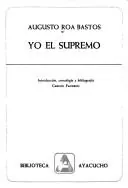
I the Supreme
Nota da comunidade
18 avaliações
1974 · Augusto Roa Bastos
Médias por categoria
Sua avaliação
Entre para avaliarEm outros sites
Notas de outros sites pertencem a eles; cada link abre a fonte.
Sinopse
Ainda não disponível em português — exibindo a versão em inglês.
I, the Supreme (orig. Spanish Yo el Supremo) is a historical novel written by exiled Paraguayan author Augusto Roa Bastos. It is a fictionalized account of the nineteenth-century Paraguayan dictator José Gaspar Rodríguez de Francia, who was also known as "Dr. Francia". The book's title derives from the fact that Francia referred to himself as "El Supremo" or "the Supreme". The first in a long line of dictators, the Supreme was a severe, calculating despot. The central themes of the novel are power and language and the relation between the two. The Supreme believes himself to be above all power and history: "I don't write history. I make it. I can remake it as I please, adjusting, stressing, enriching its meaning and truth." Yet this assertion is constantly challenged by the very fact that while he achieves power by means of writing and dictating, these very same methods can be used by others to dispute his authority. Not even his own identity, represented by the personal pronoun I, is safe and can easily be usurped as is demonstrated by the incident of the pasquinade. Language, as powerful as it is, can never be controlled and can just as easily be used as an instrument of coercion as an instrument of resistance. During the time the book was written, Paraguay was under the dictatorship of Alfredo Stroessner, who went on to rule the country even longer than Francia did. Many consider the book to be at least in part a thinly disguised attack on Stroessner who used methods similar to Francia's to achieve and maintain the effective control of the country, including the swift elimination of opposition, the employment of torture, and intolerance of dissent. In its portrayal of Francia and criticism of Stroessner, I, the Supreme belongs to the genre of novelas de dictadores or dictator novels, and also to the Latin American Boom, a literary movement of the 1960s and 1970s. The book was first published in Spanish in 1974, and in English (translation by Helen Lane) in 1986. Like many other works of the Latin American Boom, the book never became an international best-seller. It was, however, highly regarded by critics, with Gerald Martin claiming that it was "an exceptional cultural phenomenon". Martin goes on to suggest that it was "more immediately and unanimously acclaimed than any novel since One Hundred Years of Solitude, [and its] strictly historical importance [may] be even greater than that of García Márquez's fabulously successful creation." The book's handling of the themes of power and language was also praised. Still, the novel was not well received by Stroessner's government and Roa Bastos became "one of the three citizens forbidden to return" to Paraguay as a result.
Licença do texto: CC BY-SA 4.0 · Fonte
Detalhes
- Tipo
- Livro
- Lançamento
- 1 de janeiro de 1974
- Gêneros
- dictator novel, historical fiction
- Criado por
- Augusto Roa Bastos
- Países
- Paraguay