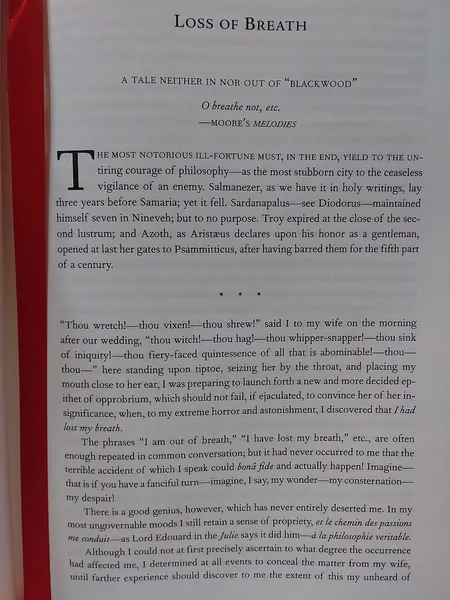
Loss of Breath
Nota da comunidade
10 avaliações
1832 · Edgar Allan Poe
Médias por categoria
Sua avaliação
Entre para avaliarEm outros sites
Notas de outros sites pertencem a eles; cada link abre a fonte.
Sinopse
Ainda não disponível em português — exibindo a versão em inglês.
"Loss of Breath", also known as "Loss of Breath: A Tale Neither in Nor Out of 'Blackwood' ", is a short story written by American author Edgar Allan Poe under the pseudonym "Littleton Barry". A satirical tale, the story is narrated by Mr. Lackobreath who recounts his attempt to find and reclaim his lost breath, which he had literally misplaced. Throughout his journey, he is repeatedly dismembered and disfigured, falsely assumed to be dead, hanged, locked away, and prematurely interred. The absurd exaggerations may be explained by the fact that the tale was meant to satirize fiction published in the Edinburgh Blackwood Magazine, which was known for its sensational texts. Inspired by the rapid scientific developments during the nineteenth century and pre-Civil War period, Poe and other writers commonly expressed their ideas and perspectives about the newfound medical culture and practices. As a result, medicine and fiction intertwined during this period. Poe used the characters and plot as devices to convey predominant aspects and concerns regarding medicine in the nineteenth century. Poe also used them to criticize practitioners with an underlying sentiment, suggested to be common during his time. Furthermore, the themes in the story reflect common philosophical movements and beliefs from the nineteenth century, such as transcendentalism and pseudoscience. An early version of the story was published in 1832 as "A Decided Loss"; it was revised as "Loss of Breath" in 1835, and further revised and printed in The Broadway Journal in 1846.
Licença do texto: CC BY-SA 4.0 · Fonte
Detalhes
- Tipo
- Livro
- Lançamento
- 1 de janeiro de 1832
- Criado por
- Edgar Allan Poe
- Países
- United States
Capa: Wikimedia Commons · Lgarc407 · CC BY-SA 4.0 · Fonte
