Lucifer
Nota da comunidade
12 avaliações
1654 · Joost van den Vondel
Médias por categoria
Sua avaliação
Entre para avaliarSinopse
Ainda não disponível em português — exibindo a versão em inglês.
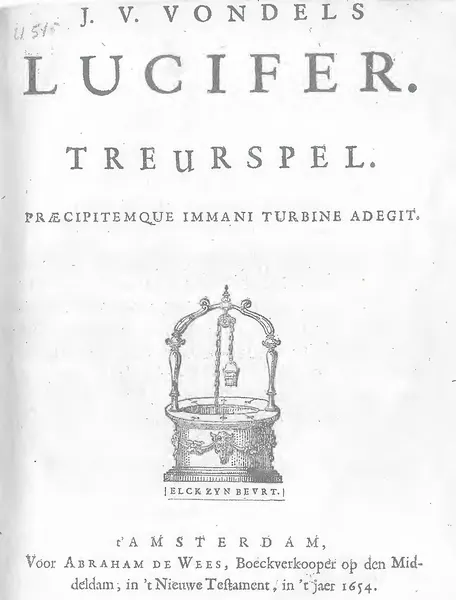
The play Lucifer is a 1654 tragedy set in Heaven, written by the Dutch playwright and poet Joost van den Vondel, and premiered on 2 February in the city theater of Amsterdam. When God decides to elevate Man above the Angels, the high-ranked angel Lucifer initiates a revolt which ends when archangel Michael ejects the revolters from Heaven with a bolt of lightning. Lucifer then avenges himself on earth by seducing Adam and Eve to commit original sin, causing their banishment from the Garden of Eden. After the second performance on February 5 the burgomasters of Amsterdam, pressed by the clergy, banned further performances. Lucifer is widely regarded as Vondel's masterpiece and one of the greatest works of Dutch literature. It has been said that Lucifer is "one of the rare products of Dutch literature that occupies a steady place in the Western canon." As a young poet, Vondel associated the Lucifer character with the theme of unjust uprising. The many examples of Luciferism in international politics of the 1640s finally prompted him to give life to the Lucifer-conception inside him. The result is an original work: though all names derive from the Bible, the plot itself is not based on any existing story. In Vondels collected plays in two octavo volumes of 1662, edited by the playwright himself, Lucifer appears in the volume with non-Biblical plays. Dedicated to kaiser Ferdinand III of the Holy Roman Empire, the play is written in alexandrines, with the choirs concluding each act in four- to three-foot iambes. The structure follows the five stages of classical Greek drama, yet timeless and spaceless Heaven does not accommodate all three of Aristotle's unities of time, place, and plot. Literary scholars have long been confused by the question whether the Fall of Man does obstruct the unity of plot. Another aspect of structure that provoked much discussion is the question whether Lucifer is already in the camp of evil from the start or if his character concurs with Aristoteles's norm for a protagonist, and so in the course of the play, after much hesitation and contemplation, becomes a member of evil. Scholarly concentration upon the theological background of the play gradually gave way to study of themes such as free will, and the relation of belief versus reason. The tragedy's parallels to the political situation of Vondel's time, remarkable as they are, do not have such bearing as to constitute a political allegory. After performance was forbidden, selling the text became officially illegal as well. Yet six reprintings of the quarto appeared in 1654 alone. The play was not performed again until the nineteenth century. In 1825 a British theory was launched, holding that Lucifer was a source for John Milton's Paradise Lost, which after initial acceptance was discredited in 1895. Lucifer has been translated into French, German, English, Hungarian and Japanese, among other languages.
Licença do texto: CC BY-SA 4.0 · Fonte
Detalhes
- Tipo
- Livro
- Lançamento
- 1 de janeiro de 1654
- Criado por
- Joost van den Vondel
Capa: Wikimedia Commons · Abraham de Wees (publisher) · Public domain · Fonte
