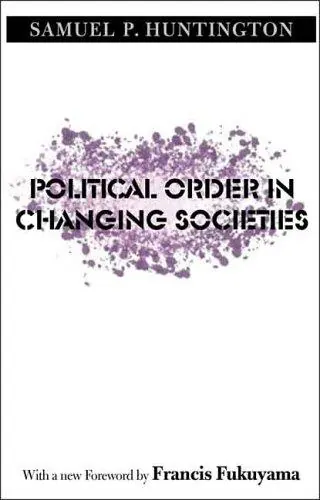
Political Order in Changing Societies
Nota da comunidade
8 avaliações
1968 · Samuel P. Huntington
Médias por categoria
Sua avaliação
Entre para avaliarEm outros sites
Notas de outros sites pertencem a eles; cada link abre a fonte.
Sinopse
Ainda não disponível em português — exibindo a versão em inglês.
With his famous book Political Order in Changing Societies, published in 1968, the American political scientist and Harvard professor Samuel P. Huntington is considered to be one of the ”Founding Fathers” of neo-institutionalism, the historical institutionalism. The book is dealing with the role of political institutions in changing political systems. Huntington stated that ”the most important political distinction among countries concerns not their form of government but their degree of government”. As stated by Francis Fukuyama, Huntington argued that political decay was "at least as likely as political development", and that neither "economic nor social development" could proceed without political order, the actual experience of newly independent countries being "one of increasing social and political disorder". For Huntington, ”the capacity to create political institutions is the capacity to create public interests”. Huntington argues that changes are caused by tensions within the political and social system, and criticizes modernization theory, contending that its argument for economic change and development being the prime factors responsible for the creation of stable, democratic political systems is flawed. Focusing on other factors like urbanization, increased literacy, social mobilization, and economic growth, he stresses that those factors are not significantly related to political development; in fact a major part of his argument is that those processes are related but distinct. For Huntington, ”political order depends in part on the relation between the development of political institutions and the mobilization of new social forces into politics”. The existence (or lack) of order should not be confused with the issue of the type of that order, both on political level (democratic, authoritarian) and on economic level (socialist, free-market). While modernity equals stability, modernization is actually a cause for instability, due to urbanization, rising expectations due to literacy, education and the spread of media, etc. In order to explain the decline in political order throughout Asia, Africa, and Latin America in the late '50s and the early '60s, Huntington stated: ”What was responsible for this violence and instability? The primary thesis of this book is that it was in large part the product of rapid social change and the rapid mobilization of new groups into politics coupled with the slow development of political institutions”.
Licença do texto: CC BY-SA 4.0 · Fonte
Detalhes
- Tipo
- Livro
- Lançamento
- 1 de janeiro de 1968
- Gêneros
- political science
- Criado por
- Samuel P. Huntington