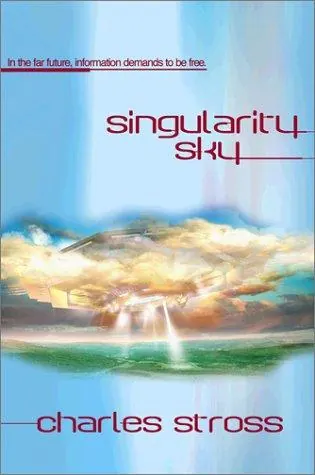
Singularity Sky
Nota da comunidade
9 avaliações
2003 · Charles Stross
Médias por categoria
Sua avaliação
Entre para avaliarEm outros sites
Notas de outros sites pertencem a eles; cada link abre a fonte.
Sinopse
Ainda não disponível em português — exibindo a versão em inglês.
Singularity Sky is a science fiction novel by British writer Charles Stross, published in 2003. A sequel, Iron Sunrise, was published that same year. Together the two are referred to as the Eschaton novels, after a near-godlike intelligence that exists in both. The novel follows the ill-fated military campaign by a repressive state, the New Republic, to retaliate for a perceived invasion of one of its colony worlds. In actuality, the planet has been visited by the Festival, a technologically advanced alien or posthuman race that rewards its hosts for "entertaining" them by granting whatever the entertainer wishes, including the Festival's own technology. This causes extensive social, economic and political disruption to the colony, which was generally limited by the New Republic to technology equivalent to that found on Earth during the Industrial Revolution. Aboard the New Republic's flagship, an engineer and an intelligence operative from Earth covertly attempt to prevent the use of a forbidden technology—and fall in love along the way. Themes of the novel include transhumanism, the impact of a sudden technological singularity on a repressive society, and the need for free information. Its narrative encompasses space opera and elements of steampunk and science fantasy. Intertwined within are social and political satire, and Stross's trademark dark humour and subtle literary and cultural allusions. Stross wrote the novel during the late 1990s, his first attempt at the form. It was not his first novel to be published, but it was the first to be originally published in book form. Its original title, Festival of Fools, was changed to avoid confusion with Richard Paul Russo's Ship of Fools. The book was well received, and earned a nomination for the Hugo Award for Best Novel in 2004. Writers have cited the book in explanations of the titular concept. Its exploration of free information helped to inspire a proposal to give every Afghan a free mobile phone to combat the Taliban.
Licença do texto: CC BY-SA 4.0 · Fonte
Detalhes
- Tipo
- Livro
- Lançamento
- 1 de julho de 2003
- Gêneros
- postcyberpunk, libertarian science fiction, science fiction
- Criado por
- Charles Stross
- Países
- United Kingdom