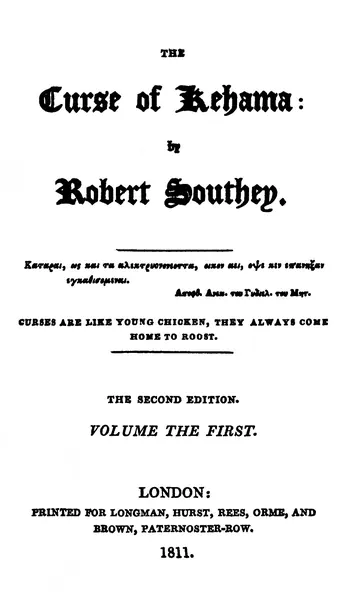
The Curse of Kehama
Nota da comunidade
7 avaliações
Médias por categoria
Sua avaliação
Entre para avaliarSinopse
Ainda não disponível em português — exibindo a versão em inglês.
The Curse of Kehama is an 1810 epic poem composed by Robert Southey. The origins of the poem can be traced to Southey's schoolboy days when he suffered from insomnia, along with his memories of a dark and mysterious schoolmate that later formed the basis for one of the poem's villains. The poem was started in 1802 following the publication of Southey's epic Thalaba the Destroyer. After giving up on the poem for a few years, he returned to it after prompting by the poet Walter Savage Landor encouraged him to complete his work. When it was finally published, it sold more copies than his previous works. The poem is divided into twelve "books". Its first half describes how the evil priest Kehama is able to gain significant amounts of demonic power in a quest to become a god. This is interrupted when his son Arvalan is killed after attempting to have his way with Kailyal, a peasant girl. After the death of his son, Kehama begins to wage war upon Yamen, the god of death, and curses Ladurlad, his son's killer. However, the curse allows Ladurlad the ability to become a hero of significant strength, and he uses that power to work with the Hindu gods in a quest to defeat Kehama and ensure the safety of Kailyal. Eventually, Ladurlad is able to defeat Kehama and is freed from his curse. Although the poem describes Hindu myth it is heavily influenced by Zoroastrian theology, and the ideal of a dualistic moral system. Part of Southey's focus on India stems from the recent British colonial expansion into India and the increasing interest by British citizens in Indian culture. Critics gave the work mixed reviews; many praised the quality of the poem's language, but others felt that the plot or choice of subject matter was lacking.
Licença do texto: CC BY-SA 4.0 · Fonte
Detalhes
- Tipo
- Livro
Capa: Wikimedia Commons · Southey · Public domain · Fonte
