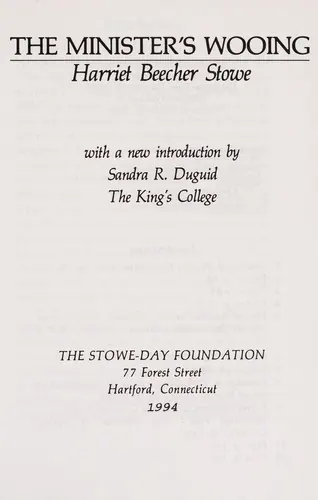
The Minister's Wooing
Nota da comunidade
10 avaliações
1859 · Harriet Beecher Stowe
Médias por categoria
Sua avaliação
Entre para avaliarEm outros sites
Notas de outros sites pertencem a eles; cada link abre a fonte.
Sinopse
Ainda não disponível em português — exibindo a versão em inglês.
The Minister's Wooing is a historical novel by Harriet Beecher Stowe, first published in 1859. Set in 18th-century Newport, Rhode Island, the novel explores New England history, highlights the issue of slavery, and critiques the Calvinist theology in which Stowe was raised. Due to similarities in setting, comparisons are often drawn between this work and Nathaniel Hawthorne's The Scarlet Letter (1850). However, in contrast to Hawthorne's The Scarlett Letter, The Minister's Wooing is a "sentimental romance"; its central plot revolves around courtship and marriage. Moreover, Stowe's exploration of the regional history of New England deals primarily with the domestic sphere, the New England response to slavery, and the psychological impact of the Calvinist doctrines of predestination and disinterested benevolence. With its intense focus upon the history, customs, and mannerisms of New England, The Minister's Wooing is one sense an example of the local color writing that proliferated in late 19th century. However, because Stowe also highlighted the issue of slavery, this time in the North, this novel is related to her earlier anti-slavery novels. Finally, the work serves as a critique of Calvinism, written from the perspective of an individual deeply familiar with the theological system. Stowe's father was well-known Calvinist minister Lyman Beecher. Stowe drew elements of the novel from events in both her and her older sister Catharine Beecher's lives. Throughout the novel, Stowe portrays the reaction of different personality types to the pressures of Calvinist principles, illustrating in this manner what she perceives as Calvinism's strengths and weaknesses. In particular, responding to the untimely death of her sister's fiancé and the deaths of two of her own children, Stowe addresses the issue of predestination. This suggested that individuals were either saved or damned at birth, and only the elect would go to heaven.
Licença do texto: CC BY-SA 4.0 · Fonte
Detalhes
- Tipo
- Livro
- Lançamento
- 1 de janeiro de 1859
- Gêneros
- historical fiction
- Criado por
- Harriet Beecher Stowe
- Páginas
- 578
- Países
- United States