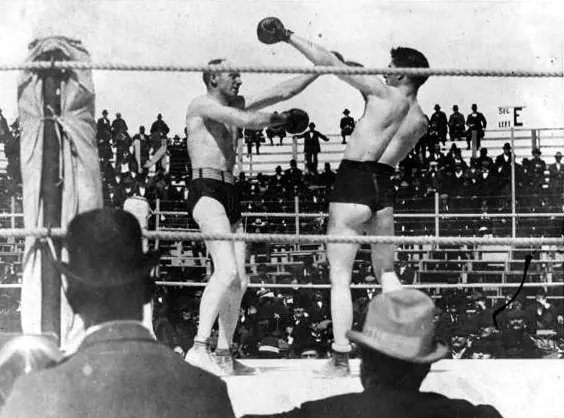
The Corbett-Fitzsimmons Fight
Nota da comunidade
11 avaliações
1897 · Enoch J. Rector
Médias por categoria
Sua avaliação
Entre para avaliarEm outros sites
Notas de outros sites pertencem a eles; cada link abre a fonte.
Sinopse
Ainda não disponível em português — exibindo a versão em inglês.
The Corbett–Fitzsimmons Fight is an 1897 documentary film depicting the 1897 boxing match between James J. Corbett and Bob Fitzsimmons in Carson City, Nevada on March 17, 1897. Directed by Enoch J. Rector, it originally ran for more than 100 minutes, making it the longest film released to date. The technology that allowed this is known as the Latham loop. Rector claimed to have invented the device, but its invention is disputed. He used three such equipped cameras placed adjacently and filming on 63mm nitrate film. Only fragments of the film survive. The known fragments were transferred in the 1980s from a print owned by Jean A. LeRoy of New York City, the transfer done on a specially built optical printer to convert the film to 35mm film. The film was also the first to be shot in widescreen, with an aspect ratio of about 1.65:1. According to Dan Streible, The Corbett–Fitzsimmons Fight is "one of the earliest individual productions to sustain public commentary on the cinema.", while Luke McKernan declared, "it was boxing that created the cinema." As noted by Seth Abraham, the president of Time Warner Sports, it was the first motion picture to ever depict the championship prizefight. Its nationwide screenings can be regarded as the first pay-per-view media event in boxing history, for the fight produced more income in box office than in live gate receipts, it was immensely profitable, and the picture served as a long-standing model for future amusement entrepreneurs. Prizefighting was illegal in 21 states, and many cities and states tried to ban the film, mostly unsuccessfully. In 2012, the film was selected for preservation in the National Film Registry at the Library of Congress, being deemed "culturally, historically, or aesthetically significant".
Licença do texto: CC BY-SA 4.0 · Fonte
Detalhes
- Tipo
- Filme
- Lançamento
- 1 de janeiro de 1897
- Gêneros
- documentary film, silent film, boxing film
- Criado por
- Enoch J. Rector
- Duração
- 100 min
- Países
- United States
Capa: Wikimedia Commons · Public domain · Fonte
