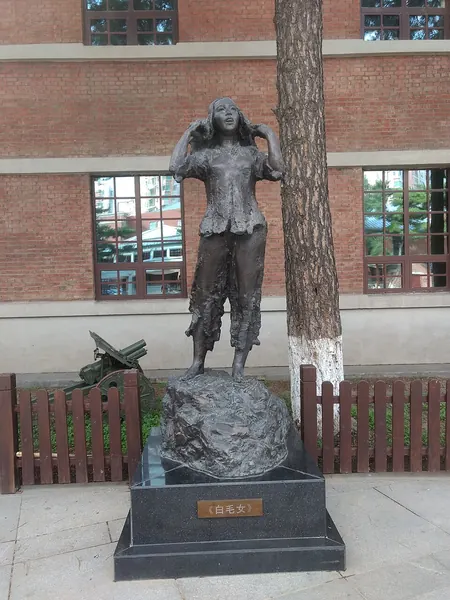
The White-haired Girl
Nota da comunidade
5 avaliações
1945
Médias por categoria
Sua avaliação
Entre para avaliarSinopse
Ainda não disponível em português — exibindo a versão em inglês.
The White-Haired Girl (Chinese: 白毛女; pinyin: Bái Máo Nǚ) is a Chinese contemporary classical opera by Yan Jinxuan to a Chinese libretto by He Jingzhi and Ding Yi. It was later adapted to a ballet, a Peking opera, and films. The ballet adaptation was regarded as a revolutionary opera and promoted by the Chinese Communist Party (CCP) as a model revolutionary work. The plot centers on a young peasant woman who flees persecution by an evil landlord and lives in a dark cave until CCP forces bring her back to the sunlit world (with some of the plot elements being revised over time and in different adaptations). The central theme of the story, in the words of the opera, is that "the Old Society changed people into ghosts, while the New Society changes ghosts into people." In the original version, the heroine becomes pregnant after being raped by the villainous landlord. After she realizes she is pregnant, she initially hopes to marry her attacker, but ultimately runs away when she realizes that she is to be sold off. The opera drew inspiration from stories circulating in the border region of Shanxi, Chahar and Hebei, describing the misery suffered by local peasantry (especially women and girls), particularly a folk story called The White-Haired Fairy Maiden. Along with Red Detachment of Women, the ballet is regarded as one of the classics in the People's Republic of China, and its music is familiar to almost everyone who grew up during the 1960s. It is one of the Eight Model Operas approved by Jiang Qing during the Cultural Revolution.
Licença do texto: CC BY-SA 4.0 · Fonte
Detalhes
- Tipo
- Filme
- Lançamento
- 1 de janeiro de 1945
- Países
- China
Capa: Wikimedia Commons · Francesc Fort · CC BY-SA 4.0 · Fonte
