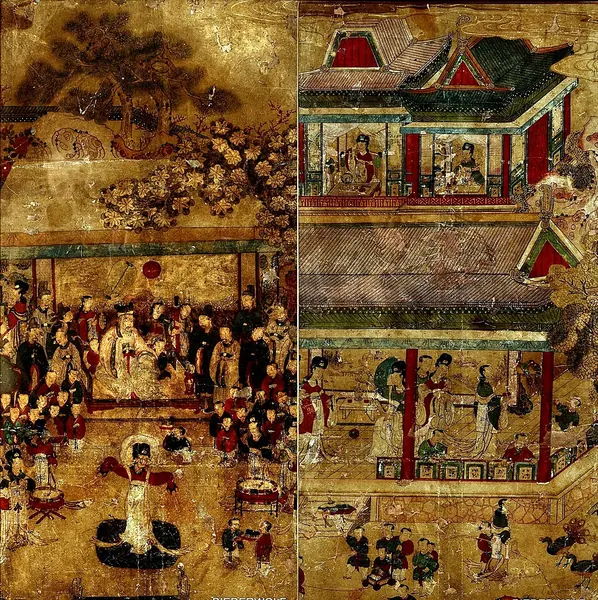
Tale of King Mu, Son of Heaven
Community score
15 ratings
Category averages
Your rating
Log in to rateSynopsis
The Tale of King Mu, Son of Heaven (traditional Chinese: 穆天子傳; simplified Chinese: 穆天子传; pinyin: Mù Tiānzǐ Zhuàn) is an ancient Chinese text that dates from the Warring States period (475–221 BC). It is a fantasy narrative version of the travels of King Mu of Zhou, historical fifth sovereign of the Zhou dynasty of China, r. 976–922 BCE or 956–918 BCE. The written originals of the fantasy biography of King Mu and a biography of his mother were found along with the Bamboo Annals in the tomb of Wei Xiang-zi (d. 296 BCE), king of Wei, rediscovered in 281 CE during the Jin dynasty (266–420), after which they were merged into a single tale during transmission. Transmitted are four textual lineages which became independent from the original. Later versions were sometimes called Zhou Wang Youxing, literally "(The) Zhou King('s) Travels" or "Travels of the Zhou King". The Ming dynasty (1368-1644) scholar Hu Yinglin regard the Tale of King Mu, Son of Heaven to be a pioneering work of Chinese fiction.
Text license: CC BY-SA 4.0 · Source
Details
- Type
- Book
- Genres
- historical fantasy
- Countries
- Wei
Cover: Wikimedia Commons · King muh · CC BY-SA 4.0 · Source
