Dandy
Community score
6 ratings
1983
Category averages
Time to beat
- Main story
- Not enough reports yet (needs 3)2 reports
- Main + extras
- Not enough reports yet (needs 3)1 report
- Completionist
- Not enough reports yet (needs 3)no reports
Median of the hours reported by players who completed the game.
Your rating
Log in to rateSynopsis
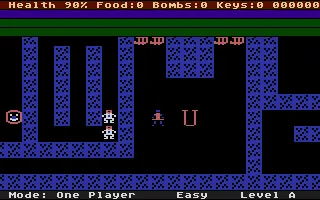
Dandy (later Dandy Dungeon) is a 1983 dungeon crawl maze video game developed by John Howard Palevich and published by the Atari Program Exchange for Atari 8-bit computers. It is one of the first video games with four-player, simultaneous cooperative play. Players equipped with bows and unlimited arrows fight through a maze containing monsters, monster spawners, keys, locked doors, food, and bombs in search of the exit leading to the next level. If a player dies, they can be revived by finding and shooting a heart. The game includes an editor for making new dungeons. Dandy was written by John Howard Palevich for his undergraduate thesis while attending MIT, drawing inspiration from Dungeons & Dragons, Defender, and arcade maze games. Some of the levels and level design elements, which have become standard in dungeon crawls, were designed by fellow student Joel Gluck. The 1985 Atari Games arcade video game Gauntlet built upon the core design of Dandy, and a lawsuit from Palevich was settled out of court. Gauntlet designer Ed Logg later called Dandy a direct influence. Electric Dreams Software published versions of Dandy for the ZX Spectrum, Commodore 64, and Amstrad CPC in 1986. Dandy was reworked into Dark Chambers by Atari Corporation under license from Palevich for the Atari 2600, Atari 7800, and Atari 8-bit computers. The name Dandy is a play on D&D, the common abbreviation for Dungeons & Dragons.
Text license: CC BY-SA 4.0 · Source
Details
- Type
- Game
- Release date
- January 1, 1983
- Genres
- dungeon crawl, action-adventure game, action game, maze video game
- Platforms
- Atari 8-bit family, Atari 2600, Atari 7800
- Countries
- United States
Cover: Wikimedia Commons · John Howard Palevich · Apache License 2.0 · Source
